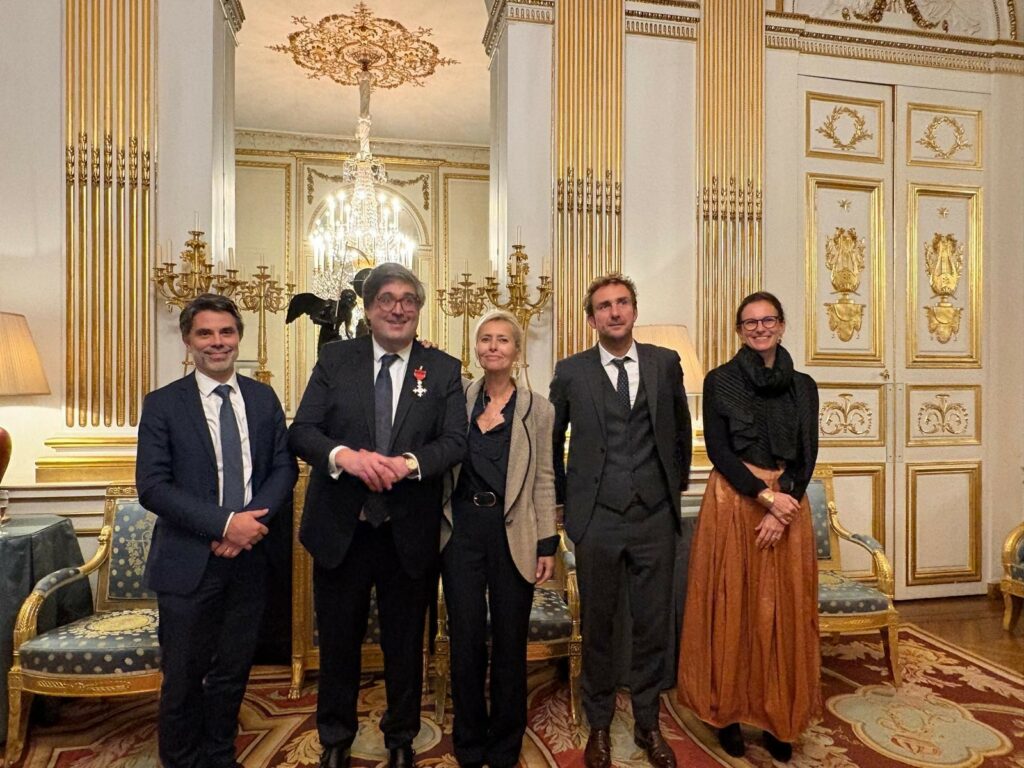
Thomas Ricard receives the insigna of the Most Excellent Order of the British Empire (MBE)

We are extremely proud of our partner, Thomas Ricard, who has been honored by the British Crown, receiving the insignia of the Most Excellent Order of the British Empire (MBE).

It is in recognition of his services to British nationals living in France, and notably for his exceptional commitment during the “13 November” trial, that Thomas RICARD is the first French lawyer to be awarded the badge of the Order.

Congratulations, Thomas, on this well-deserved honor.

DISPARAGEMENT: SANCTION OF A CEASE-AND-DESIST LETTER INFORMING RESELLERS OF A “POSSIBLE INFRINGEMENT”

Cass. com., 15 October 2025, No. 24-11.150, published in the Bulletin

IMPACT: By this ruling, the Court of Cassation held that information communicated by a copyright holder to third parties regarding the existence of a “possible infringement of its own products and acts likely to fall within the scope of unfair and parasitic competition” constitutes disparagement where it is not based on a prior court decision.

Accordingly, the Court of Cassation censured the sending of a cease-and-desist letter stating that the marketing of the disputed products was “liable to constitute an act of copyright infringement” or that such sales were “at the very least, likely to be characterised as acts of unfair and parasitic competition.”

  • The facts

By an order dated 22 September 2022, served and enforced on 9 November 2022, the company KOSHI was authorised to carry out a copyright infringement seizure to the detriment of the company MANUFACTURE DU MARRONNIER, which had entrusted the company VBV INTERNATIONAL with the manufacture, storage and distribution of wooden wind chimes.

On 15 November 2022, KOSHI sent a cease-and-desist letter to several distributors of MANUFACTURE DU MARRONNIER and VBV INTERNATIONAL, demanding that they immediately cease offering these chimes for sale and promoting them on their website, and further requiring them to provide all related contractual documentation.

The letter stated in particular that the “Heola” range of chimes reproduced “the essential characteristics of KOSHI chimes”, which was “liable to constitute an act of copyright infringement”, and further asserted that such acts were “at the very least, likely to be characterised as acts of unfair and parasitic competition”.

The recipients were invited to “immediately cease offering [the products] for sale” and to “communicate all necessary information” in order to determine the quantities purchased, sold and in stock, failing which KOSHI and its director indicated that they would “regain full freedom of action, including by taking all necessary measures, in particular legal action”.

MANUFACTURE DU MARRONNIER and VBV INTERNATIONAL initiated summary proceedings against KOSHI seeking an order to cease the manifestly unlawful disturbance constituted by the sending of this letter and the payment, by way of an advance, of damages for disparagement of the products manufactured and marketed by their companies.

By a judgment dated 9 November 2023, the Montpellier Court of Appeal dismissed their claims, leading MANUFACTURE DU MARRONNIER and VBV INTERNATIONAL to lodge an appeal before the Court of Cassation.

  • Disparagement arising from informing third parties of a “possible infringement”

On the basis of Article 1240 of the French Civil Code, the Court of Cassation reiterated that disparagement is established “where, in the absence of a judicial decision confirming the existence of acts of copyright infringement, the mere fact of informing third parties of a possible infringement of such rights amounts to disparagement of the products alleged to be infringing.”

Therefore, informing a third party to a legal proceedings of a “possible infringement” may therefore now constitute disparagement. 

In the present case, KOSHI sent a cease-and-desist notice to twelve retailers of MANUFACTURE DU MARRONNIER and VBV INTERNATIONAL. KOSHI set out what it presented as factual elements relating to the existence of its copyright and asserted that the sale of the products in question was “liable to constitute an act of copyright infringement”, or that such sales were “at the very least, likely to be characterised as acts of unfair and parasitic competition”.

It further informed them that it reserved the right to take any legal action against them to protect its rights and seek compensation for its loss.

The Court of Cassation held that, in ruling that these statements were measured and not coercive and therefore did not constitute disparagement, the Montpellier Court of Appeal had breached Article 1240 of the Civil Code.

PATENTS: PARIS COURT OF APPEAL’S ASSESSMENT OF THE PRACTICE OF INTERMEDIATE GENERALISATION

Paris Court of Appeal, Division 5 Chamber 2, 13 June 2025, No. 23/02588

IMPACT: In this ruling, the Paris Court of Appeal addresses the practice of intermediate generalisation, which consists of extracting a specific feature by isolating it from an originally disclosed combination of features, subject to strict constraints.

The Court also penalises, on grounds of disparagement, the patent holder’s publication of an announcement on its website mentioning the filing of an infringement action, even though it was not based on sufficient factual grounds.

  • The facts

The US company Intellectual Ventures LLC (IV), which specialises in the creation, development, acquisition and exploitation of inventions, is the holder of a European patent entitled “Organisation of data encryption in a wireless communications system,” designating France.

Considering that SFR’s “Auto Connect WiFi” service—which allows subscribers to automatically switch from the mobile network to the SFR WiFi Mobile network using EAP-SIM technology—implemented several claims of the patent, IV obtained, in October 2016, an order for an infringement seizure.

Following the execution of the seizure at SFR’s premises, IV brought infringement proceedings against SFR before the Paris Judicial Court in November 2016.

On 3 February 2017, a bailiff’s report recorded that IV had announced the filing of the infringement action in the “news” section of its website. SFR then filed a counterclaim for disparagement.

By a judgment dated 25 October 2022, the Court annulled the claims at issue on the grounds of added subject-matter, dismissed the infringement action and found IV liable for disparagement. The Court of Appeal upheld the judgment in its entirety.

  • Invalidity of the patent for “intermediate generalisation”

The Court first recalled that, pursuant to Article L. 614-12 of the Intellectual Property Code, a European patent designating France may be revoked on one of the grounds set out in Article 138(1) EPC, in particular where the subject-matter of the granted patent extends beyond the content of the application as filed.

To determine whether the subject-matter of the claims extends beyond the content of the original application, the Court referred to the practice known as “intermediate generalisation”, which it defined as “the extraction of a characteristic in isolation from its specific context”, that is, detached from a specific embodiment and not closely linked to the other features of that embodiment.

Such a generalisation is justified only “in the absence of any clearly recognisable functional or structural relationship between the features of the specific combination” or “if the extracted feature is not inextricably linked” to those features.

More specifically, intermediate generalisation is admissible only “if the skilled person can recognise without any doubt, from the application as filed, that the features taken from a detailed embodiment are not closely linked to the other features of that embodiment and that they apply directly and unambiguously to the more general context.”

In this case, IV had isolated the feature according to which encryption was performed at the MAC layer of a wireless local area network, while deleting the original reference to the WEP protocol, even though, for the skilled person, these features are closely and functionally linked. The Court therefore found that dissociating them resulted in a claim extending beyond the content of the original application, and confirmed the invalidity of claims 1, 11 and 14 of the French part of the patent.

  • Public disclosure of the infringement action constituting disparagement

On the basis of Article 1240 of the Civil Code, the Court reiterated that disparagement may be found “even in the absence of direct and effective competition,” where “information likely to cast discredit on a marketed product” or on an operator is disseminated without sufficient factual basis.

In this case, IV had published on its own website, on the very day the writ of summons was served, a notice announcing the filing of an infringement action against SFR before the Paris District Court, using the following wording (here translated into French): “Today, Intellectual Ventures has brought an infringement action against SFR before the court.”[1]

The Court emphasised that this publication:

  • was accessible to the French public, including SFR’s customers;
  • disclosed the existence of an infringement action;
  • lacked a sufficient factual basis, as it was based solely on the writ of summons;
  • did not relate to a matter of general interest.

Accordingly, the Court held that the publication in question constituted an act of disparagement harming SFR’s image and upheld the order requiring IV to pay €50,000 in damages, as awarded at first instance, without giving any further detail on how the damages were assessed.


[1] In its original English version: “Today Intellectual Ventures filed a patent infringement complaint against Société Française du Radiotéléphone – SFR before the District Court. ”


Newsletter

Subscribe to our newsletter to be informed of our news

Privacy Overview

This website uses cookies so that we can provide you with the best user experience possible. Cookie information is stored in your browser and performs functions such as recognising you when you return to our website and helping our team to understand which sections of the website you find most interesting and useful.